
 SAFE PAYMENT
Secure payments directly managed by banks. ATM, MBWay and Paypal available.
 FREE SHIPPING FROM 25€
Deliveries in 2 to 3 business days (except holiday period).
 CUSTOMER SUPPORT
We are available to clarify all your doubts.
Contents
| Preface to the English Edition
| Preliminaries and Framing
| Introduction to the Law of the United States of America
| Constitutional Interpretation Methodologies
| Decisions of the Supreme Court of the United States
| Justices of the Supreme Court of the United States
| A Chronological Table of the Featured Justices
| The Making of a Court
| The Roots of American Common Law
| The Financial Constitution
| The Court in the Vortex
| 250 Years: From Bunker Hill to the Courtroom
| Annotated Bibliography
| Table of Selected Cases
| Index of Referred Names
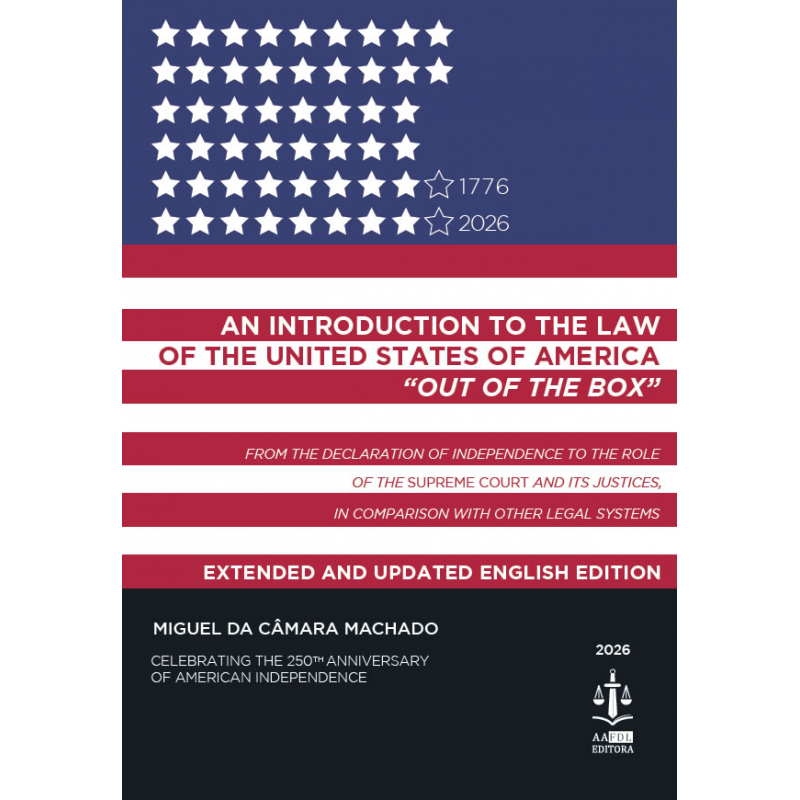
On 4 July 1826 – fifty years to the day after the Declaration of Independence – John Adams and Thomas Jefferson, the rivals and friends who had together given the Republic its founding words, died within hours of one another. It is a coincidence no novelist would dare to invent. Two centuries on, and two hundred and fifty years after the Revolution itself, this commemorative edition returns to the country they built – and to the Supreme Court that, more than any other institution, made American law.
Long awaited, and born of more than fifteen years teaching Comparative Law at the Faculty of Law of the University of Lisbon, this book follows part of the path students take each year – from the Civil Law of France, Germany and Portugal to the Common Law of England and the United States, and on to the Islamic, Hindu, Chinese and African traditions – pausing where attention always lingers longest. For we grown up reading, watching and hearing American justice at work – from Perry Mason to To Kill a Mockingbird, from the evening news to Hamilton – and it is often through those encounters that many come to the law at all, and to the dream of a more just and better world.
Returning to the age of the Revolution, it travels across two and a half centuries through the Court’s landmark decisions – from Marbury v. Madison, which first gave judges the power to strike down a law, to Dred Scott and Brown v. Board of Education, Roe and Dobbs, Bush v. Gore and the dramatic rulings of 2024–2026 on presidential immunity, tariffs and birthright citizenship. Each is set beside the judgments of other courts – English Common Law, French Civil Law and, above all, the Portuguese Supreme Court of Justice and, especially, the Constitutional Court, the closest counterpart to the Supreme Court itself. The Portuguese and French extracts are translated into English, so that readers everywhere can weigh the American answers against those of the Civil Law world, and against their own.
At its heart are three “teams” of nine – for nine is the Court’s unchanging number – the classics, the moderns and the current Court. Here are the men and women who shaped a nation’s law: John Marshall, who made the Court a power in its own right; Oliver Wendell Holmes, the “Great Dissenter”; the lone, prophetic dissent of the first Justice Harlan in Plessy v. Ferguson; Brandeis and Cardozo; and the unlikely friendship of Scalia and Ginsburg across the deepest of divides – together with a tribute to Learned Hand, the greatest judge never to sit on the Court. Each is portrayed in original drawings by the author.
A new chapter asks how the Constitution should be read at all – the battle for meaning between those who seek the original understanding and those who see a living text – while a closing illustrated chapter returns to the roots of the Common Law, offering four reasons why English, and then American, law took its singular path. For the curious of every age, a generous guide to further reading runs from primary sources and scholarship to graphic novels, adventures and legal thrillers.
American constitutionalism, judicial review and the Supreme Court continue to shape debates over democracy, rights, privacy and the rule of law far beyond the United States – and rarely more so than today. As William Howard Taft, the only person to have served both as President and Chief Justice of the United States, once observed, “the world is not going to be saved by legislation.” Good law, however, helps. Written “out of the box” for lawyers and non-lawyers alike, this book is an invitation to understand a tradition whose arguments , begun in the eighteenth century, remain very much our own.